How Doctor Time built it
A kid wakes up on their 13th birthday knowing everything their adult self knew, on the day that adult walked into Doctor Time's lab. That's not magic. Doctor Time built the machine that did it, out of four pieces of real physics.
It's not everything they'll ever know. It's everything their older self knew that one day, whether that's a version of them at forty or at eighty. After the download they're on their own again. Still growing up. Still learning the rest for themselves.
Four things science already knows, in four fields that don't usually talk to each other. Each piece is real and published. Doctor Time is the one who worked out how to wire them together.
Who's telling you this

Doctor Time
He talks fast. He's a genius and he knows it, and he's always in a hurry to get to the next thing. Most people can't keep up with him, and when they can't, he loses patience with them fast.
Slow him down and he's kind. Thoughtful, even. He just doesn't slow down much.
He only built one of these before this one. He doesn't talk about what it did to him. Ask Penelope.

Penelope
She's British, quick-witted, and she runs the lab. Doctor Time thinks he does. She gives him more grief than anyone alive gets away with, and he misses most of the jokes.
She's the heart of this place, and most of the laughs too.
Penelope has her secrets too.
Here's how it works, one piece at a time.
Why thirteen: the one door still open
Your brain is elastic at thirteen. The real word for it is plasticity. The connections can still change.
It only does this much one other time in your life, and that's when you're a baby. You didn't get a vote on that one.
At thirteen your brain is still deciding what to keep. The connections you use get stronger. The ones you don't use get weaker, and some go away for good. Use it or lose it, and you're old enough this time to feel it happening.
You can still shape it at thirteen. You can't at forty.
That's why things stick at thirteen in a way they don't at forty. Psychologists call it the reminiscence bump. Ask anyone what they remember best about their own life and most of them point back to being young. Not because more happened to them. It's because you were paying closer attention to your own life right then than you ever have since.
Adolescent plasticity and pruning: Trends in Cognitive Sciences, 2015. The reminiscence bump: PLOS ONE, 2018.
A clock that never dies
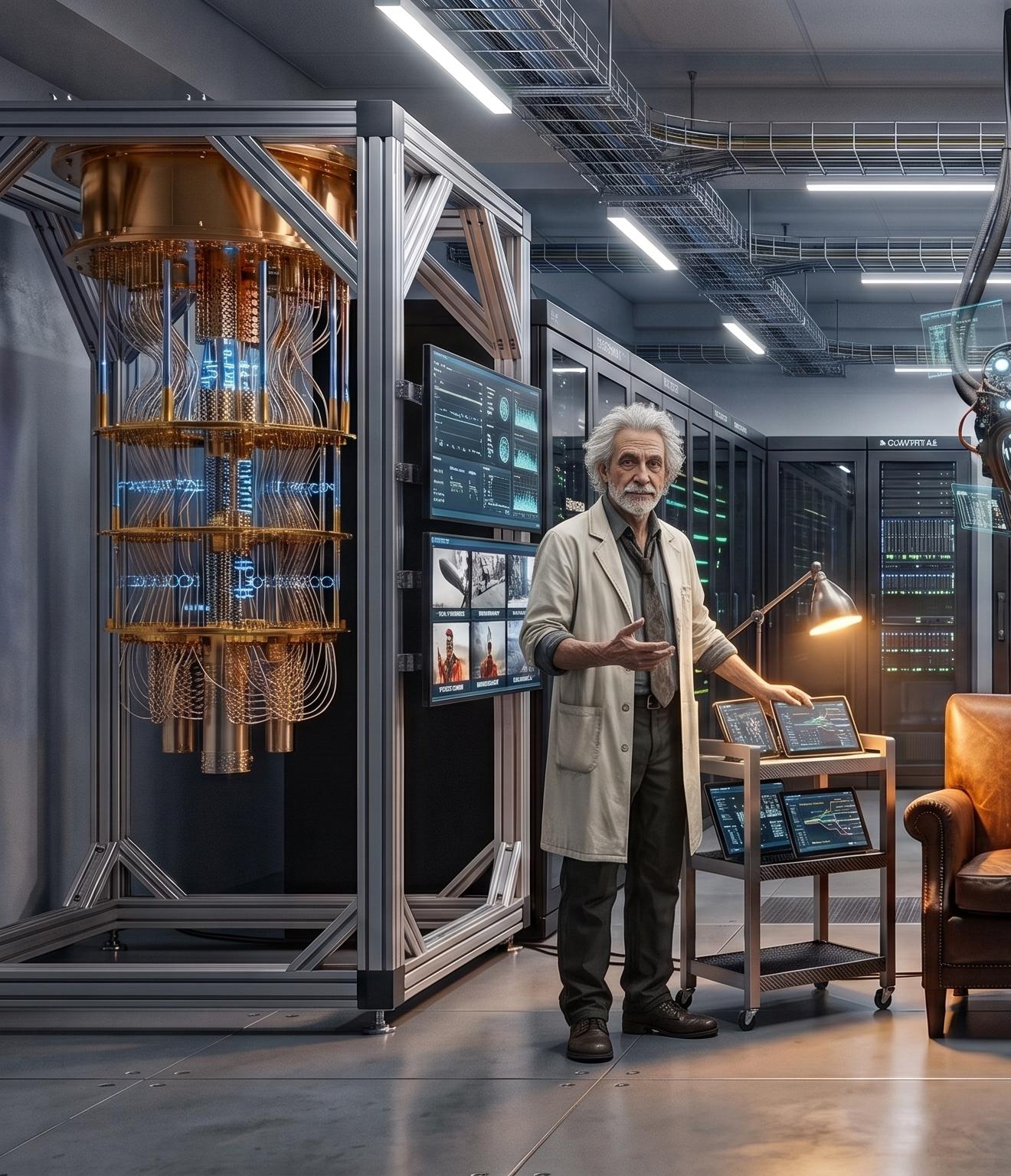
The time crystal itself, mid-lecture. He does this a lot.
Take an ordinary crystal. It's a pattern frozen in space. Atoms locked into the same shape, over and over. In 2012 a Nobel-winning physicist named Frank Wilczek asked a strange question. Could you freeze a pattern in time instead? Something that just keeps cycling, forever, without burning any energy to do it.
People told him that couldn't work. In 2021 Google built one anyway, inside a quantum computer, and it kept perfect time.
That's the piece you'd need if you were trying to find one specific night, forty years back, and not miss it by a decade. A clock that never drifts, not even across a whole human life.
A wire between you and you
Two particles can get linked so completely that whatever happens to one happens to the other, no matter how far apart they sit. Einstein hated the idea. He called it spooky action at a distance. Scientists have tested it every way they can think of since, and it holds up every time.
For those few seconds, you and your thirteen-year-old self would be entangled.
A machine like this wouldn't send you a message the way a radio does. It would link the mind you have now to the mind you had at thirteen, straight across the whole distance of your own life.
Why it arrives as a dream
Quantum information doesn't last. Leave it alone too long and it falls apart into ordinary noise. Physicists call this decoherence, and the way they fight it is by cooling their machines down colder than deep space.
So the download can't trickle in slow. It has to land all at once, in one burst, while the connection holds. A whole lifetime of knowledge, into a living thirteen-year-old brain, in a single night.
There's only one way a brain can take in that much at once. Not a voice in your ear. Not words on a screen. A dream. The most vivid dream you've ever had in your life.
The dream is the download. It already happens to you. This just points it somewhere.
You wake up with all of it. Nobody hands you proof. Nobody hands you a source. You're just certain, and you've got nothing to back it up with.
How do you prove a dream?
Time may not be the line you think it is
You think of your life as a line. Born at one end. Moving forward. The end somewhere you haven't reached yet. Relativity killed the idea of one universal "now" a century ago. In the plain reading of Einstein's own spacetime, past, present, and future are all equally real. He called the difference between them a stubbornly persistent illusion.
And in 1983 two physicists, Page and Wootters, showed that time itself may emerge from entanglement. The same thing that would carry the message is the thing time is made of. Your thirteenth birthday isn't gone. In this version of physics, it's exactly as real as right now.
The Page–Wootters mechanism, illustrated experimentally in 2013.
The science underneath it. Every piece above is real and published. Nobody else put them together into a machine. Doctor Time did.
That's the whole point. The question on the front page isn't a fairy tale. It's a dare.